Coordinated Robot Operation
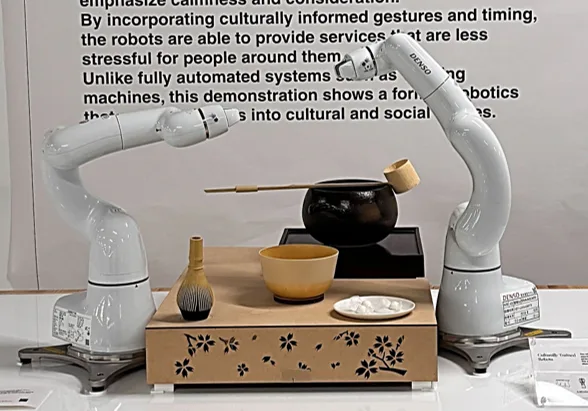
This demonstration features two robots performing coordinated tea-serving operations
based on motion teaching inspired by Japanese cultural practices.
Rather than relying on advanced situational recognition,
the robots operate using predefined motion sequences, precise timing,
and clearly taught roles to achieve calm and stable performance.
Overview
In this exhibition, robot motion is taught by referencing
clear procedures, careful movements, and precise timing
drawn from Japanese tea ceremony practices.
Based on culturally informed motion teaching,
two robots perform stable and coordinated operations
designed to fit naturally into human environments.
Key Points
- Coordinated operation by multiple robots
- Motion teaching based on Japanese cultural practices
- Service robotics demonstration
How the Robots Work Together
The two robots are taught complementary roles and fixed timing.
One robot performs the primary service actions,
while the other supports the operation by maintaining position and consistency.
Through precise motion teaching,
the robots operate together as a stable and predictable pair.
Service Experience Flow
1. Setup
Preparing the workspace and setting initial robot states.
2. Initiation
A demonstration phase before moving into tea service,
based on tea ceremony practice.
3. Coordination
Performing synchronized tea-ceremony motions
based on predefined timing and roles.
4. Completion
Completing the service with calm, composed motion.
Design Approach
This demonstration focuses on teaching motion quality
rather than automating decision-making through situational interpretation.
By encoding culturally informed gestures and timing into robot motion,
the robots demonstrate how service robots can be designed
to operate calmly and consistently in social and cultural spaces.
About the Demonstration
This is not a fully automated service system like a vending machine.
Instead, it presents an approach to robotics
that emphasizes cultural compatibility,
repeatable operation, and calm presence in shared spaces.
Credits
Cloud Services R&D Division
Research & Development Center
DENSO CORPORATION, Japan